

The Art of Coping with Malaise
How writing once again saved me

Over the past several months, I found myself floundering in a very uncomfortable rut. It was a feeling of something being off, unease, discomfort, and pain all rolled in together to weigh me down. At first I called it just a funk, then a deeper funk, then eventually I labeled it malaise.
What exactly is malaise? Medical authorities call it a general feeling of discomfort, illness, or lack of wellbeing, an overall feeling of fatigue, and loss of energy to do everyday tasks.
I can pinpoint when it started. During a business trip, I injured an already weak shoulder and suffered excruciating pain and loss of mobility. As a combat veteran with PTSD and a sexual assault survivor, I’ve had my share of pain, both physical and emotional. This hit differently.
Weeks turned into months, and the pain and limited mobility evolved into depression. Those of you who have experienced shoulder pain or rotator cuff or labral tears know of what I speak. I finally got an MRI approved, and it showed lots of words ending in “itis.” I ended up with a tear, tendonitis, arthritis, and frozen shoulder.
No wonder I found it hard to get dressed, wash my hair, dry off, or put on a shirt. Forget about putting on a jacket. Good thing I live in a warm climate. Everyday tasks seemed insurmountable. There were days that I fell to my knees with unbearable pain.
I began to wall myself off from loved ones. I stopped working on my current book project. I would respond to work requests but didn’t initiate any. I hid what I was feeling from others. When I did work or speak at an event, I did it with a polished professionalism and was told how much people appreciated me and my work. I was able to do this due to years of successfully mastering compartmentalization.
My outward appearance and expression never showed what was really going on in my head. I didn’t want to do anything at all. I went through the motions of existing, but couldn’t escape the listlessness, fatigue, pain, anger, and lack of feeling human.
I tried to maintain an exercise routine, as I know how vital that is to my body and mind. I couldn’t swim my usual laps for exercise, couldn’t bring my shoulder out of the water when I attempted to swim freestyle. All I could do was walk. But even doing this became less frequent than I liked. My first bout of physical therapy was not effective, due to the pain and extreme limited range of motion. I couldn’t do the exercises properly and walked away frustrated and disappointed in the lack of progress.
I began to realize that the pain and inability to do normal tasks had evolved into depression, a malaise. I also realized that due to my experiences as a woman, combat veteran, and sexual assault survivor, I was at high risk for depression. Studies have shown links between military sexual trauma and increased rates of depression, as well as combat veterans having a higher rate of depression than civilians.
Okay, so now what? I finally got in with the right doctors, physical therapists, and chiropractor. Got a steroid shot so the pain could ease enough to do the exercises and stretches. Then I started talking about this depression, this malaise, with others, especially with friends who are psychologists and therapists.
This helped, but what really helped me start to get out of this rut was writing about what I was feeling. For me, writing about my experiences has always been therapeutic and a way for me to move beyond trauma and, now, depression.
I encourage those of you experiencing depression to not be afraid to get help from professionals, friends, and colleagues. I was able to fall back on the tools that my EMDR therapist taught me a few years ago when I was confronting my trauma. I used the biggest tool in my toolkit to chip away at my depression: poetry. The arts have always helped me work through any trauma. The poem titled “Malaise,” shown at the end of this article, best fits how I was feeling and demonstrates how I use the power of my pen to confront and manage my mental health and wellbeing. Getting thoughts out of my head and onto paper is the beginning of how I do just that.
Andrea Davis, founder and executive director of Dallas Art Therapy, says:
The creative process, whether through writing, visual art, or other expressive forms, gives us a language for experiences that words alone cannot capture. When we engage with art during times of depression or trauma, we’re not just processing pain; we’re actively reclaiming our narrative and rebuilding our sense of agency. The tools we use to create become the tools that help us express and heal, allowing us to move from surviving to thriving.
The deep funk is not calling the shots anymore; I am. I am owning my narrative and rewriting my story, no longer allowing depression to take the reins of my life. I’m working through it both physically and mentally. I’ve turned the corner and can now see daylight.
Malaise
by Colonel Lisa Carrington Firmin, USAF RetiredAn intense malaise permeated
every cell of my body and mind
causing havoc unabatedThe invader came disguised
as pain and grew into anger
then depression residedThe funk greedily
ate up my good cheer
attacking my very essence gleefullyEveryday tasks unbearable
The intruder controlled me
Thoughts and actions unrepairableEvolved into a deep malaise
Fatigue and despair reigned supreme
Nothing mattered, stuck in a mazePretended that I was okay
Outward appearance belied
the turmoil in disarray
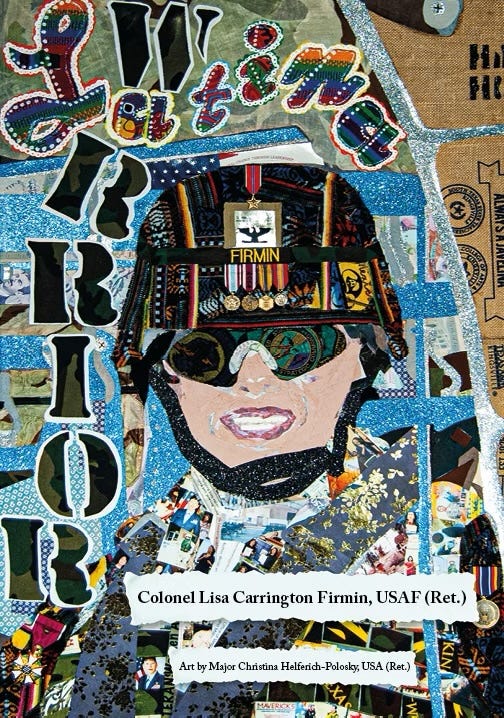
Lisa Carrington Firmin is the author of Stories from the Front: Pain, Betrayal, and Resilience on the MST Battlefield and Latina Warrior, both published by Blue Ear Books, and co-editor of the Blue Ear Books Veteran Book Initiative. She is working on a book about veteran entrepreneurs.
 | A guest post by
|